Thinking about a Mission Bay or Dogpatch condo and wondering if you can reliably charge your EV at home? In these dense, newer-build neighborhoods, on-site charging can be a game changer for your daily routine. You want clarity before you write an offer: Will your stall support Level 2, what will the HOA allow, and how much will it cost? This guide breaks it all down, step by step, so you can buy with confidence. Let’s dive in.
Mission Bay and Dogpatch reality check
Mission Bay and Dogpatch have many newer condo buildings, which often means better EV readiness. Still, not every garage is plug-and-play. Curbside charging is limited, so your building’s parking type, electrical capacity, and HOA policies matter. For background on multi-unit charging best practices, the U.S. Department of Energy’s guidance is a helpful starting point.
Step 1: Confirm your parking status
Your charging path depends first on how your parking is structured.
- Deeded parking. You own the stall as part of your title. This is typically the smoothest path for a personal Level 2 charger, subject to HOA rules and permits.
- Assigned parking. The stall is assigned but owned by the HOA as common area. You will need HOA approval for electrical work and a written agreement covering costs, maintenance, and removal if required.
- Unassigned, guest, or valet parking. Personal charging is usually not feasible. Your best option is shared, common-area chargers managed by the HOA or a vendor.
Ask the listing agent to confirm, in writing, whether the stall is deeded or common area, and whether there is an existing 240V outlet or conduit nearby. A quick walk-through to the electrical room can tell you a lot about feasibility.
Step 2: Review HOA rules and process
Every building handles EV charging a bit differently. In California, HOAs generally cannot unreasonably block EV installations, but you must follow the building’s stated approval process. Request these documents early:
- CC&Rs, bylaws, and architectural guidelines that mention EV charging
- Any HOA policy or board resolution on EV installations
- The standard owner-installation agreement, including insurance and indemnity requirements
- Recent meeting minutes that reference EV infrastructure or electrical upgrades
If the HOA has a clear policy and a reasonable application timeline, you will have a much easier time. Ask for specifics: approval steps, who pays for common-area electricity, whether visible conduit is allowed, and the process for billing or submetering.
Sample language you can use: “Please provide the HOA’s most recent EV-charging policy, the typical approval timeline, and a copy of the standard owner-installed charging agreement.”
Step 3: Check building electrical capacity
Even if the HOA is supportive, the building’s electrical design drives cost and timing.
- Service type. Buildings with individual unit meters make personal charging simpler because you can often tie into your unit’s meter. In master-metered buildings, the HOA typically manages common-area electricity and must set up billing or submetering.
- Spare capacity. Ask about available capacity at the main service and the parking-level panels. Limited capacity can mean panel upgrades, new feeders, or, in rare cases, utility transformer work.
- Conduit pathways. If there is existing conduit from the electrical room to the garage, your install may be straightforward. Long runs or slab penetrations drive costs up.
- Load management. Smart load-sharing solutions let multiple Level 2 chargers share a single feeder by capping combined power. That can avoid big upstream upgrades and support future growth. For technical background, see NREL’s research on managed charging.
A quick diagram or a site walk with a qualified electrician can confirm whether your stall is close to power and what an install might involve.
Step 4: Pick your charging approach
In Mission Bay and Dogpatch garages, Level 2 is the standard.
- Level 1 (120V). Very slow. Works only if you have low daily miles and long overnight dwell times.
- Level 2 (240V). The sweet spot for condos. Expect roughly 20 to 30 miles of range per hour of charging.
- DC fast charging. Rare in residential garages due to high power demand and cost. Use public stations when you need a quick top-up.
If you will use shared chargers, clarify how reservations and billing work. Many buildings use networked systems that bill per kilowatt-hour or per session. Vendors like ChargePoint support hardware, networking, and user billing in one platform, which reduces HOA admin.
Step 5: Understand costs and incentives
Installation cost depends on distance to power, panel capacity, and whether you or the HOA will upgrade infrastructure.
- Charger hardware. Mid-range Level 2 units often run about 300 to 800 dollars. Premium models can cost more. For a consumer overview, see EnergySage’s cost guidance.
- Typical single-stall install. If capacity exists and conduit runs are short, many installs fall in the 800 to 3,000 dollar range.
- Complex retrofits. Long conduit runs, new panels, or utility work can push costs to 5,000 to 25,000 dollars per stall or more. Building-wide upgrades can reach tens or hundreds of thousands, which is why load management can be valuable.
Incentives can reduce costs materially. Utility programs have helped multifamily properties with “make-ready” infrastructure and rebates that offset common-area work. Program names and amounts change, so confirm the latest details on PG&E’s site. San Francisco also provides local EV charging resources and guidance through the Department of the Environment.
Step 6: Plan your timeline
Even simple installations require a few steps. In San Francisco, expect:
- HOA review and approval, often 30 to 60 days depending on meeting schedules
- Permit application and issuance, a few weeks for straightforward work
- Installation and inspection, usually days to weeks depending on scope
Complex retrofits, vendor contracts, or utility coordination can extend timelines to several months. Build this into your purchase planning if home charging is essential.
Buyer checklist: EV charging due diligence
Use this checklist before you remove contingencies. Keep answers and documents in writing.
Documents to collect
- CC&Rs, bylaws, and architectural guidelines
- HOA EV-charging policy and standard owner-installation agreement
- Parking deed or assignment documentation
- Recent HOA meeting minutes mentioning EV charging or electrical upgrades
- Electrical one-line diagrams or a basic description of service and panel locations
- Records of prior EV installs, including how billing is handled
- Copies of permits and any installer quotes related to charging
Questions for the listing team or seller
- Is the parking stall deeded to the unit or part of HOA common area?
- Is there a dedicated meter, panel access, conduit, or a 240V outlet near the stall?
- Are Level 2 chargers already installed in the building, and where are they located?
- Has the building completed any electrical upgrades recently that support EV charging?
- Are there reserved stalls or signage for EV-only parking?
- Does the seller have an executed EV charging agreement with the HOA?
Questions for the HOA or property manager
- Do you have a written EV-charging policy and a standard approval process? Please share it.
- What is the typical approval timeline for an owner-installed charger?
- Will the HOA allow conduit runs or hardware in common areas, including slab penetrations if needed?
- Who pays for common-area electricity, and is submetering allowed for stalls?
- Are there existing contracts with a charging vendor for hardware, networking, and billing?
- Has the HOA applied for or received any utility make-ready funds, and are building-wide upgrades planned?
Practical evaluation steps
- Request a short site visit to view your stall and the path to the electrical room.
- Ask a qualified electrician or EV charger vendor for a high-level opinion and an estimate.
- Collect two to three quotes, including an option that uses smart load management.
Sample language you can use: “Please confirm in writing whether parking stall X is deeded to the unit or designated as HOA common area,” and “Please provide any available electrical one-line diagram, or permission to arrange an electrical site assessment.”
What EV-ready looks like in these neighborhoods
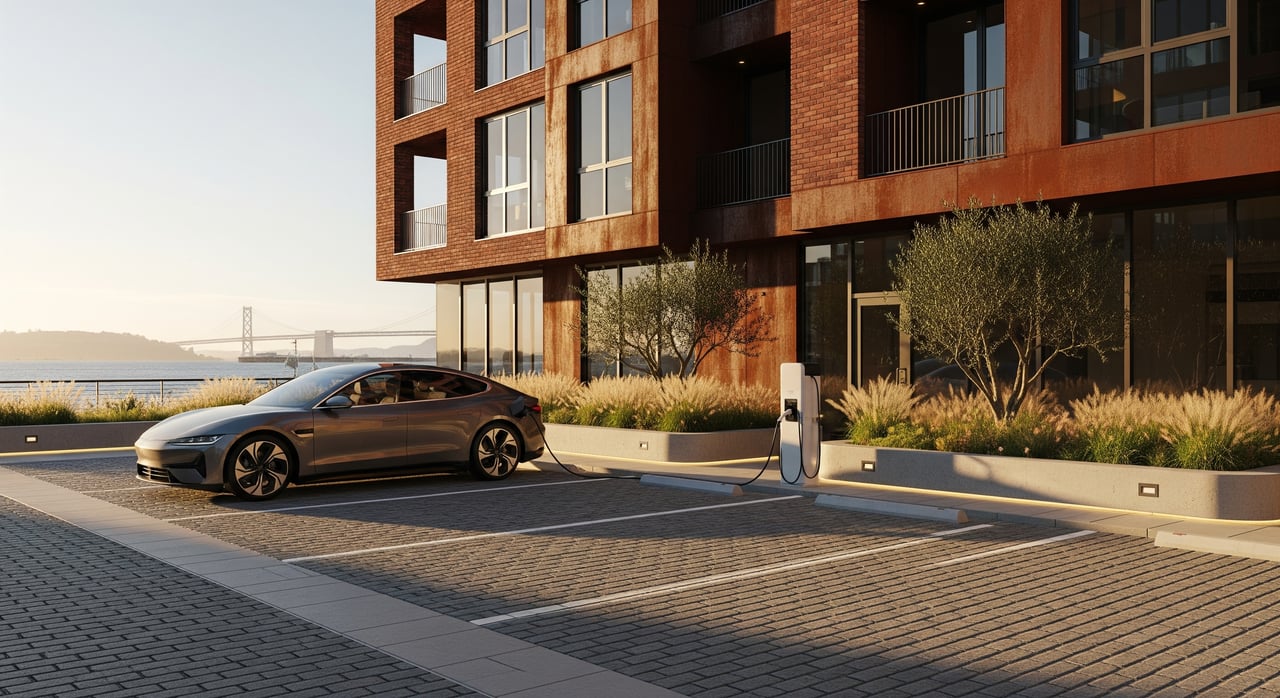
When a Mission Bay or Dogpatch building is EV-ready, you will usually see visible Level 2 chargers, signage, or dedicated EV zones in the garage. Listings may mention EV-ready wiring, a 240V outlet at the stall, or vendor contracts for managed charging. HOA minutes referencing infrastructure investments and recent electrical permits are also good signs.
Because buildings change quickly, verify readiness on a case-by-case basis. You or your agent can check San Francisco permit records, contact the HOA directly, and request a site assessment from a qualified installer.
Practical pathways that work
You do not need a perfect building to make EV charging feasible. These pathways are common in Mission Bay and Dogpatch garages:
- Owner-installed Level 2 charger. Best fit when your stall is deeded and near power. Requires HOA approval and a permit.
- Shared, common-area chargers. Ideal when stalls are assigned or unassigned. The HOA or a vendor manages access, billing, and maintenance.
- Vendor-managed hub. A third-party platform provides hardware, networking, and billing. This can reduce HOA administration and may offer flexible financing.
- Load-managed expansion. Start with a few Level 2 chargers behind a shared feeder and add more as demand grows, using smart load management to stay within capacity.
For more technical context on load management and multi-unit strategies, review NREL’s managed charging research and the U.S. Department of Energy’s multifamily charging resources.
How we help you buy with confidence
You deserve clarity before you commit. As a boutique brokerage focused on Mission Bay, Dogpatch, and nearby urban markets, we help you:
- Target buildings more likely to be EV-ready and verify the details with the HOA and management
- Gather the right documents, from CC&Rs to any EV policies or vendor contracts
- Coordinate site visits and introductions to qualified installers for quotes
- Negotiate practical terms, like keeping EV approvals and responsibilities in writing before close
If you are buying new construction, ask about our Urbane SF channel. For qualifying buyers, it can include a one-year HOA incentive that helps offset ownership costs while you set up charging and settle in. We can also point you to current utility and city resources, including PG&E’s EV programs and San Francisco EV guidance.
Ready to find the right condo and charging setup for your lifestyle? Reach out to Madison Hunter. We will help you confirm the facts and buy with confidence.
FAQs
What should I check first about EV charging in a Mission Bay or Dogpatch condo?
- Start with parking type, HOA policy, and proximity to electrical panels. Deeded stalls near power with a clear HOA process are the most straightforward.
How long does an EV charger approval and install usually take in San Francisco condos?
- Many owners see 30 to 90 days from application to install, depending on HOA meeting schedules, permit timelines, and contractor availability.
What does a typical Level 2 install cost for a condo parking stall?
- Mid-range chargers often cost 300 to 800 dollars for hardware, with installations commonly 800 to 3,000 dollars when capacity and conduit are nearby.
Can I install a personal charger if my stall is assigned or in common area?
- Possibly, but you will need HOA approval and a written agreement for installation, power usage, maintenance, and removal terms.
How do buildings bill for electricity when using shared chargers?
- Networked systems often bill per kilowatt-hour or session directly to users, or the HOA may use submetering or flat fees for cost recovery.
What if the building lacks spare electrical capacity for multiple EVs?
- Smart load management can let several Level 2 chargers share one feeder by capping total power, which often avoids expensive service upgrades.
Where can I learn more about incentives and technical best practices?
- Review PG&E’s EV resources, San Francisco EV guidance, DOE multifamily charging materials, and vendor insights like ChargePoint.